Around 300 wells (at +/- 1600 ft) were tested and found to have sidestream flush rates averaging 75 bpd per well. The Sidestream Flush Restrictor (SFR) was implemented field-wide eliminating the necessity of a needle valve by maintaining a steady drip, restricting fluids to roughly 10 bpd per well and also allowing for the pumping unit to be slowed down. Average electricity savings came to 1.2 HP per well ($450 /well /yr) and helped facilitate pumping failure reduction. Implementation of the SFR in 700 wells saved over $1 million dollars per year (3 months payout) due to less well failures along with electricity savings of 625 kilowatts per well.
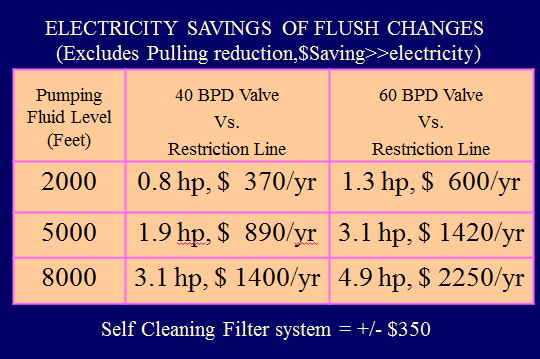
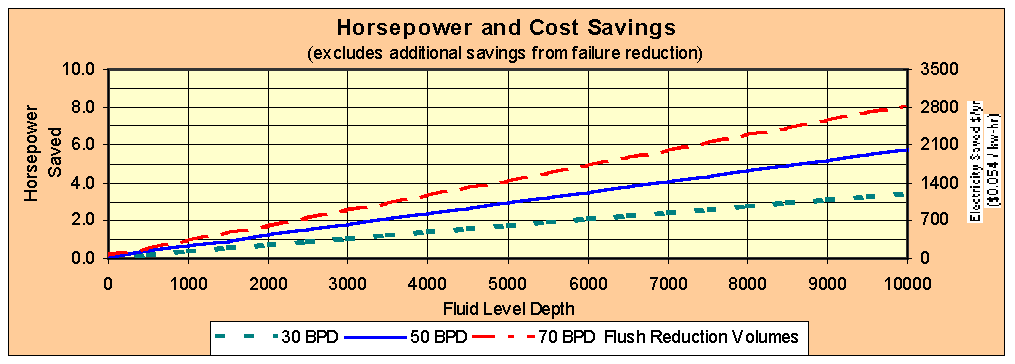
The SFR can be tested to determine the fluid rate reductions with potential savings shown in the attached chart. Additional savings from a more reliable chemical operation and less lifting fluids is not factored into the chart, but will often be more valuable than any electricity or fuel savings.
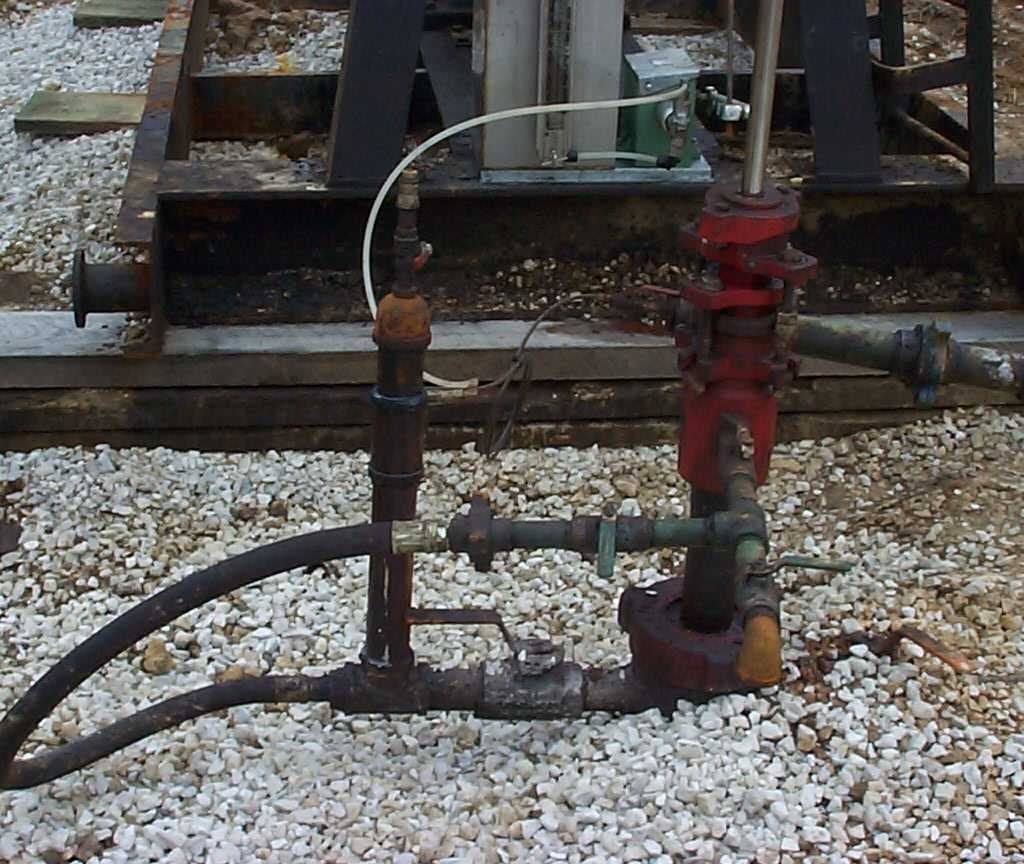
Installation on 1" Pump Tee
Testing the needle valve and SFR arrangement requires one to disconnect the line to the annulus and timing the fluids entering a container (if safely performed). Adjustment to the flowrate may need to be made if the casing pressure is not atmospheric.
The adjustment in rate would be roughly: Qactual = Qtest_diff * {(WHPavg-Csg Pressavg)/ (WHPavg)}** 0.5 (square root function), where Qtest_diff = Difference in Flush Rates tested into a container at atmospheric pressure WHPavg = Average wellhead pressure at pump tee Csg Pressavg = Average Casing Annulus Pressure
HISTORY: A well with a needle valve sidestream installation was tested and yielded a rate of 85 BPD (Barrels per Day) with an average wellhead pressure of 110 psi and a casing pressure of 80 psi. A SFR was installed and the flush was tested at 10 BPD. The pumping fluid level is around 5000 feet. Using the equation above, the Qactual would be +/- 40 bpd = 75 bpd * {(110-80)/110} ** 0.5 = 75 * 0.52 Using the chart above, the electricity savings would be around 2.4 Horsepower and $1000/yr/well.